Krakow is a city where a single walk takes you past a medieval market square, a royal castle and a former Jewish district full of cafés. Whether you’re coming for a weekend with friends or family or on a company trip, Krakow attractions are easy to combine into a plan that doesn’t need a car.
We’ve chosen 15 places that are really worth seeing – from Old Town classics to less obvious spots in Podgórze and Nowa Huta. The list is divided into sections, so it’s easy to match it to the number of days you have and your sightseeing pace.
The Old Town – the place to start
1. Rynek Główny and the Cloth Hall
Rynek Główny (the Main Market Square) is one of the largest medieval squares in Europe and the natural starting point for any visit. In the middle stands the Sukiennice (Cloth Hall): souvenirs are sold on the ground floor, while upstairs is the Gallery of 19th-Century Polish Art, with canvases by Matejko and Chełmoński.
2. St Mary’s Basilica and the bugle call
The Gothic basilica with its two unequal towers is one of the symbols of Krakow. Inside, don’t miss the Veit Stoss Altarpiece; outside, listen for the hejnał (bugle call). Firefighters play it from the taller tower every hour, around the clock, towards the four points of the compass. The melody breaks off halfway through – according to legend, at the point where a Tatar arrow struck the watchman.
3. The Royal Route and the Planty
Droga Królewska (the Royal Route), once followed by royal processions, leads from the Barbican and St Florian’s Gate along Floriańska Street and across the Market Square, then down Grodzka Street to Wawel. The Old Town is encircled by the Planty – a green belt laid out where the city walls once stood, perfect for a breather between sights.
4. Rynek Underground
A few metres beneath the Market Square lies a multimedia route through medieval Krakow. You’ll see sections of old trade routes uncovered during excavations and learn what life was like for merchants centuries ago. The entrance is by the Cloth Hall.
5. Collegium Maius
The oldest building of the Jagiellonian University charms visitors with its Gothic arcaded courtyard. The university museum holds historic scientific instruments and mementoes of Nicolaus Copernicus, who studied in Krakow. The interiors can only be seen with a guide, so check the tour times in advance.
6. Czartoryski Museum
The museum on Pijarska Street is home to Leonardo da Vinci’s Lady with an Ermine – one of the most precious paintings in Polish collections. The same collection, part of the National Museum in Krakow, also includes Rembrandt’s Landscape with the Good Samaritan.
Wawel and the Vistula
7. Wawel Hill
The Royal Castle and the cathedral where Polish monarchs were crowned and buried are the heart of the city’s history. The royal chambers and the treasury are visited on separate routes, but the castle courtyard is impressive even on a short visit. On your way down towards the Vistula, look into the Smocza Jama (Dragon’s Den) – by the exit stands the fire-breathing Wawel Dragon.
8. The Vistula Boulevards and the Father Bernatek Footbridge
The boulevards below Wawel are a favourite spot for walks, bike rides and evening get-togethers by the water. Head downstream and you’ll reach the Kładka Ojca Bernatka (Father Bernatek Footbridge), which links Kazimierz with Podgórze. Above the walkway hang sculptures of balancing acrobats by Jerzy Kędziora.
Kazimierz and Podgórze
9. Kazimierz
The town founded by King Casimir the Great was the centre of Jewish life in Krakow for centuries. On Szeroka Street stands the Old Synagogue, home to a branch of the Museum of Krakow, and a few steps away is the still-active Remuh Synagogue with its Renaissance cemetery. In the evening, life moves to Plac Nowy (New Square) and the surrounding streets full of cafés and bars.
10. Schindler’s Factory and MOCAK
The administrative building of Oskar Schindler’s former factory on Lipowa Street houses the exhibition Krakow under Nazi Occupation 1939–1945. It tells the story of the city’s Polish and Jewish residents during the war and is one of the most moving exhibitions in Krakow. It’s worth buying tickets online in advance. Right next door is MOCAK, the Museum of Contemporary Art.
11. Podgórze
Podgórze begins on the other side of the footbridge. On Plac Bohaterów Getta (Ghetto Heroes Square), chairs commemorate the residents of the ghetto, and the Apteka pod Orłem (Eagle Pharmacy), run during the war by Tadeusz Pankiewicz, has kept its original fittings. Finish by climbing the Krakus Mound – the top offers a wide panorama of the city.
Beyond the city centre
12. Nowa Huta
This district, built after the war around a steelworks, is one of the most interesting examples of socialist realist urban planning in Europe. A walk from Plac Centralny (Central Square) along Aleja Róż (Avenue of Roses) reveals wide avenues and monumental residential buildings. It’s also worth walking on to the Arka Pana (Ark of the Lord) church, whose shape resembles a boat.
13. Kościuszko Mound
Raised in honour of Tadeusz Kościuszko on Sowiniec Hill, the mound is one of the best-known viewpoints in Krakow. In good weather you can see the whole city from here, and when the air is exceptionally clear, even the Tatra Mountains. A 19th-century Austrian fort has survived around the mound.
14. Wieliczka Salt Mine
A dozen or so kilometres from the centre lies one of the most famous mines in the world, a UNESCO World Heritage Site. The tourist route leads through salt chambers, passages and underground lakes, and its best-known highlight is St Kinga’s Chapel, carved out of salt. Allow at least half a day for the visit.
15. Krakow from the windows of a party tram
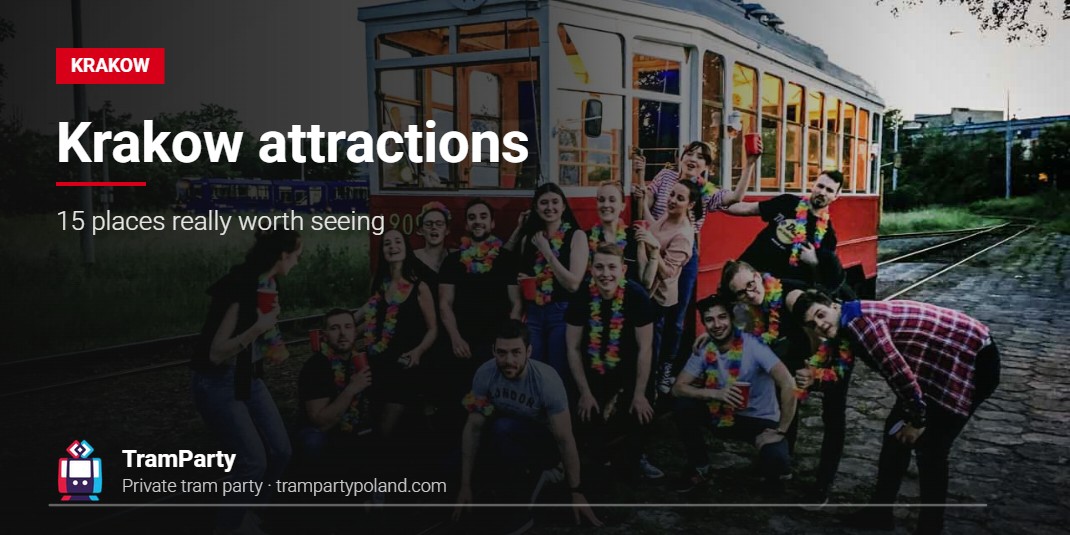
Finally, an attraction you won’t find in the classic guidebooks. A private TramParty tram is a club on wheels with a professional sound system and dance-floor lighting – and you’re the only passengers. We plan the route individually: it can run along the Planty, past Wawel and through Kazimierz and Podgórze. You’ll find the details on the TramParty Krakow page.
Practical tips
- One day – the Royal Route, the Market Square, Wawel and an evening in Kazimierz.
- Two days – add Podgórze, Schindler’s Factory and the Rynek Underground.
- Three days or more – time for Wieliczka, Nowa Huta and the Kościuszko Mound.
- Tickets – buy them online for the most popular museums and the mine, especially at weekends.
- Opening hours – museums close on different days, so check opening times before you go.
Krakow attractions: frequently asked questions
What can you see in Krakow in one day?
Walk the Royal Route from the Barbican across the Main Market Square to Wawel, then head to Kazimierz in the afternoon. If you have time left, go down into the Rynek Underground or cross the footbridge to Podgórze.
Which Krakow attractions work well on a rainy day?
Go for the museums: the Rynek Underground, Schindler’s Factory, the Czartoryski Museum and the gallery in the Cloth Hall. Whatever the weather, you can also head underground at the Wieliczka Salt Mine.
What occasions can you book a party tram for in Krakow?
Practically any – from a stag do and a hen party to a birthday, a corporate event or another special occasion. We agree the price and the programme individually, depending on what you’re looking for.
Book your private tram party
Round off your sightseeing on a private tram with a professional sound system and club lighting, reserved just for your group in Krakow. Send us an enquiry and we’ll prepare an offer.