


Wroclaw wins you over on your very first walk: the colourful Rynek (Market Square), the Odra with its islands and bridges, little bronze dwarfs on the pavements and a UNESCO-listed landmark just a few tram stops from the centre. If you’re planning a trip with friends, here are the things to do in Wroclaw that are genuinely worth your time – not just the ones on the postcards.
The list covers 15 places – from the dwarfs to Hydropolis – grouped by area, so it’s easy to plan a day or a whole weekend. We’ve covered the city after dark separately in our guide to Wroclaw at night, so here we focus on what looks best by day.
Old Town
1. The dwarfs
Bronze dwarfs are Wroclaw’s most recognisable symbol. The first of them, Papa Krasnal, has stood since 2001 on the corner of Świdnicka and Kazimierza Wielkiego streets, where the Orange Alternative movement staged its happenings. Today there are hundreds of figures on windowsills, by lamp posts and at the entrances to bars and shops, and hunting for them gets every group hooked.
2. The Rynek and the Old Town Hall
By day, take a close look at the Gothic town hall with its richly decorated facade, the tenement houses around the square and the two narrow Jaś i Małgosia (Hansel and Gretel) houses, joined by an arch next to St Elizabeth’s Church. The Rynek is the natural starting point for this part of the list.
3. The Crown of Wroclaw – the city from above
Five viewpoints make up the so-called Crown of Wroclaw: the tower of St Elizabeth’s Garrison Church by the Rynek, Mostek Pokutnic (the Penitents’ Bridge) between the towers of St Mary Magdalene’s Church, the University’s Mathematical Tower, the cathedral tower on Ostrów Tumski and the terrace on the 49th floor of Sky Tower. You collect a stamp from each one on a special card – a ready-made group challenge.
4. University of Wroclaw and Aula Leopoldina
The university’s baroque main building stands right by the Odra. Inside is the Aula Leopoldina, one of the most spectacular interiors in the city, full of gilding, sculptures and ceiling paintings. Szermierz (the Fencer), one of Wroclaw’s first dwarfs, also lives near the university.
5. District of Four Denominations
West of the Rynek, around Włodkowica and Kazimierza Wielkiego streets, the White Stork Synagogue, a Catholic church, an Orthodox church and a Lutheran church stand a few minutes’ walk from each other. The quarter is also called the District of Mutual Respect and shows the city’s multicultural history well.
6. Hala Targowa (Market Hall)
The market hall on Piaskowa Street was built in 1906–1908 to a design by Richard Plüddemann. Its reinforced-concrete structure, daring for its time, still impresses, and the market beneath it still sells fruit, vegetables and local delicacies. A good place for a snack on your way to Ostrów Tumski.
Ostrów Tumski and around
7. Ostrów Tumski by day
The oldest part of Wroclaw is calmer by day – a good time to visit the Cathedral of St John the Baptist, climb to the viewing terrace in its tower and stroll the cobbled lanes between the churches. On the way, by Most Piaskowy (Sand Bridge), look out for the Pracz Odrzański dwarf.
8. Botanical Garden
Just behind the cathedral, on Sienkiewicza Street, lies the University of Wroclaw Botanical Garden, founded in 1811. Greenhouses with thousands of plants, an alpine garden and ponds offer a welcome break from the city bustle. The garden is open seasonally, from spring to autumn.
9. Racławice Panorama
Jan Styka and Wojciech Kossak’s monumental canvas measures 15 by 114 metres and depicts the Battle of Racławice of 1794. It hangs in a circular rotunda on Purkyniego Street and surrounds visitors on all sides – the sense of space impresses even people who usually avoid museums.
Centennial Hall and Szczytnicki Park
10. Centennial Hall and the Pergola
Built in 1911–1913 to a design by Max Berg, Hala Stulecia (Centennial Hall) has been a UNESCO World Heritage Site since 2006. Its reinforced-concrete dome is 69 metres in diameter, and next to it stand the Pergola around a pond and the steel Iglica (Spire). The hall still hosts concerts, sporting events and conferences.
11. Japanese Garden
Right next to the hall, in Szczytnicki Park, is the Japanese Garden, laid out for the Centennial Exhibition of 1913. Water features and several dozen species of Asian plants, including many found only in Japan, make it one of the most peaceful spots in the city. The garden is closed in winter, so plan it for the warmer months.
12. Zoo and the Africarium
Opposite Centennial Hall is Poland’s oldest zoo, opened in 1865 and the largest in the country by number of species. Its star attraction is the Afrykarium (Africarium), an oceanarium devoted entirely to African wildlife, where you can see sharks, rays, hippos and manatees, among others.
Off the beaten track
13. Depot History Centre
The former bus depot at Grabiszyńska 184, where the Wroclaw strike began in August 1980, now houses a modern museum, Centrum Historii Zajezdnia. Its exhibition “Wroclaw 1945–2016” shows how the city’s population was almost entirely replaced after the war and how the new residents rebuilt it. Thousands of photos, films and multimedia make the time fly.
14. Hydropolis
This centre of knowledge about water occupies a historic clean-water reservoir from 1893 on Na Grobli Street. Across more than 4,000 square metres you’ll find multimedia rooms, exhibitions about the inhabitants of the seas and oceans – from great sharks to microorganisms – and a walk-in bathyscaphe modelled on the famous Trieste. Entry is at set times, so buy tickets online in advance.
15. Wroclaw from a party tram
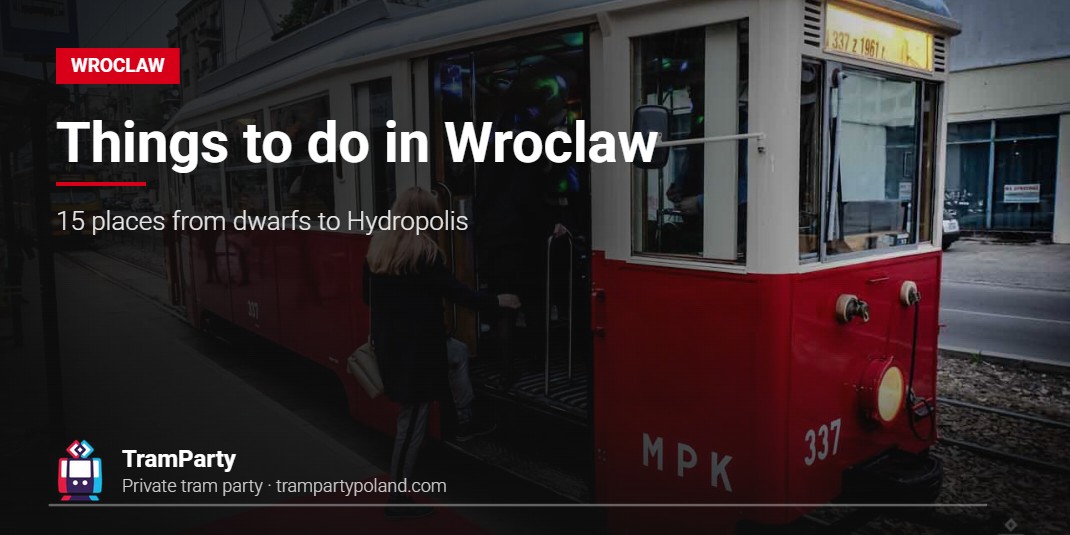
To finish, something you won’t find in guidebooks: a tram with a professional sound system and club lighting, hired just for your group. The route is agreed individually – it can take in Most Grunwaldzki (Grunwaldzki Bridge) and the area around Centennial Hall, then end in the centre, not far from the Rynek. You’ll find the details on the TramParty Wroclaw page.
Practical tips
- Day one – the Old Town, the dwarfs, one of the viewing towers and Ostrów Tumski, all within walking distance.
- Day two – Centennial Hall, the Japanese Garden and the zoo sit side by side, so see them in one go and take a tram back to the centre.
- Tickets – at weekends, buy tickets for Hydropolis, the Racławice Panorama and the zoo in advance, and check opening hours before you go.
- Season – the gardens look their best from spring to autumn; save the museums and Hala Targowa for a rainy day.
- Evening – after sightseeing, head for the Rynek or the riverside, or book a private tram for a birthday or a stag do.
Things to do in Wroclaw: frequently asked questions
Which Wroclaw attractions can you see in one day?
Go for the Rynek and its dwarfs, one of the viewing towers, Ostrów Tumski and either the Racławice Panorama or Hydropolis. If you have time left, take a tram to Centennial Hall and the Japanese Garden.
How much time do you need to explore Wroclaw?
You can see the main sights in the centre in one busy day. For the whole list – including Centennial Hall, the zoo and the museums – it’s best to set aside a weekend.
Can you book a party tram in Wroclaw for a small group?
Yes. We have offers for smaller groups of up to 30 people as well as for larger groups of over 30. Prices and details are agreed individually, depending on what you have in mind.
Book your private tram party
Round off your Wroclaw sightseeing with a party on a private tram with music and club lighting. Send us an enquiry and we’ll prepare an offer.